
ChemTorch Overview#
This overview gives you a quick glimpse of the main modules and how they fit together. What we’ll cover:
the high-level components,
how the core modules wire them together, and
how to assemble everything in code.
Configuration is covered separately in Understanding Configs.
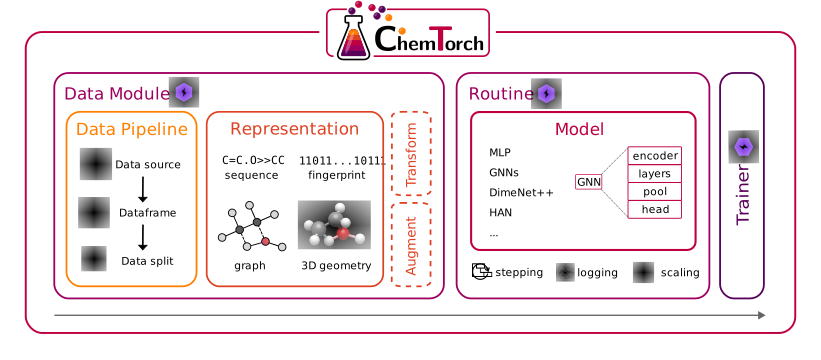
ChemTorch pipeline: raw data → data pipeline → representation → transform → model#
Note
If you prefer a linear walk-through, check out
Building a ChemTorch Pipeline from Scratch or run the interactive notebook
at docs/source/examples/pipeline_from_scratch.ipynb.
Components (chemtorch.components)#
Data Pipeline#
The data pipeline loads raw chemical data, standardizes column names, and splits into train/val/test sets. It is composed of three swappable components that transform data step-by-step:
Data Source — Loads raw data from CSV or other sources:
from chemtorch.components.data_pipeline import SingleCSVSource

source = SingleCSVSource(data_path="data.csv")
df = source.load()  # Returns pandas.DataFrame
Column Mapper — Filters and renames columns to match ChemTorch’s expected format (e.g.,
smiles,label):from chemtorch.components.data_pipeline import ColumnFilterAndRename mapper = ColumnFilterAndRename( smiles="rxn_smiles", label="barrier_energy", ) df_mapped = mapper(df) # Returns pandas.DataFrame (same rows, renamed/filtered columns)
Data Splitter — Divides data into train/val/test sets. Returns a
DataSplitobject:from chemtorch.components.data_pipeline import RatioSplitter splitter = RatioSplitter(train_ratio=0.8, val_ratio=0.1, test_ratio=0.1) data_split = splitter(df_mapped) # Returns DataSplit(train=..., val=..., test=...)
The three are orchestrated by SimpleDataPipeline:
from chemtorch.components.data_pipeline import SimpleDataPipeline

pipeline = SimpleDataPipeline(
    data_source=source,
    column_mapper=mapper,
    data_splitter=splitter,
)
data_split = pipeline()  # Runs: load → map → split
Representation#
The representation converts chemical structures (typically SMILES strings) into data structures suitable for neural networks (e.g. tensors or graphs). ChemTorch provides multiple representations, for example the Condensed Graph of Reaction (CGR):
from chemtorch.components.representation.graph import CGR

representation = CGR(
    atom_featurizer=...,  # Composition of atomic featurizers (e.g., atom type, charge, aromaticity)
    bond_featurizer=...,  # Composition of bond featurizers (e.g., bond type, aromatic)
)

# Apply to a single SMILES
data_obj = representation.construct("CC>>CCO")  # Returns a graph data object
Transform / Augmentation#
Transforms are optional pre-processing or augmentation steps applied to individual/batched data objects. For example, we can add positional encoding to graphs:
from chemtorch.components.transform import RandomWalkPETransform

# Add random walk positional encodings to graph nodes
transform = RandomWalkPETransform(walk_length=16)

data_obj = representation.construct("CC>>CCO")
transformed = transform(data_obj)  # Adds positional encodings to the graph
Other graph transforms could include dummy node injection, node/edge masking, and subgraph sampling.
Model#
Models are PyTorch nn.Module architectures that take in data objects and produce predictions.
ChemTorch emphasizes modular, composable models.
Graph Neural Networks (GNNs) are a prime example because they can be hierarchically decomposed into four components:
Encoder: projects node/edge features to hidden dimension
Layer Stack: repeatedly applies message-passing blocks (e.g., DMPNN, GIN, GAT)
Pool: aggregates node embeddings to graph embedding
Head: final fully-connected layer(s) for prediction
Each component can be swapped (e.g., different encoder, different message-passing layer, different pooling strategy) without touching the others, making GNNs highly modular.
Directed Message-Passing Neural Network (D-MPNN) example:
import torch

from chemtorch.components.layer import LayerStack
from chemtorch.components.layer.gnn_layer import (
    DMPNNBlock,
    DMPNNConv,
    DMPNNStack,
    EdgeToNodeEmbedding,
)
from chemtorch.components.model.gnn import DirectedEdgeEncoder, GNN, GlobalPool

def make_dmpnn_block():
    return DMPNNBlock(
        graph_conv=DMPNNConv(in_channels=256, out_channels=256),
        hidden_channels=256,
        residual=True,
        ffn=True,
    )

model = GNN(
    encoder=DirectedEdgeEncoder(
        in_channels=num_node_features + num_edge_features,
        out_channels=256,
    ),
    layer_stack=DMPNNStack(
        dmpnn_blocks=LayerStack(layer=make_dmpnn_block, depth=4),
        edge_to_node_embedding=EdgeToNodeEmbedding(
            embedding_size=256,
            num_node_features=num_node_features,
        ),
    ),
    pool=GlobalPool(aggr="mean"),
    head=torch.nn.Linear(256, output_dim),
)

# Forward pass
output = model(batch)  # batch is a batched graph of single graph data objects
Core Modules (chemtorch.core)#
ChemTorch’s core modules are built on top of PyTorch Lightning, which provides a standardized, high-quality training loop (device placement, logging, checkpointing, distributed execution). You do not need to be a Lightning expert to use ChemTorch—common workflows and simple components work out of the box. If you plan to go beyond implementing individual components and want to adapt the core modules themselves, we recommend skimming the Lightning tutorials or a short crash course to get familiar with LightningModule, LightningDataModule, and Trainer.
Data Module#
The Data Module is a LightningDataModule and wires together the data pipeline, representation, and optional transforms/augmentations:
Runs the pipeline (load → map → split) to get a
DataSplit/DataFrame.Applies the representation to construct model-ready data objects.
Wraps datasets and instantiates dataloaders for
train,val,test, andpredict.
Basic usage:
from functools import partial

from torch_geometric.loader import DataLoader

from chemtorch.core import DataModule

data_module = DataModule(
    data_pipeline=pipeline,
    representation=representation,
    dataloader_factory=partial(DataLoader, batch_size=64),
    transform=None,
    augmentations=None,
)

train_loader = data_module.train_dataloader()
val_loader = data_module.val_dataloader()
test_loader = data_module.test_dataloader()
Routine#
The Routine is a LightningModule that wraps the model and training logic (loss, optimizer, LR scheduler, metrics, and step hooks). Use a specific routine for your task (e.g., regression or classification).
Example (regression):
import torch

from chemtorch.core import RegressionRoutine

routine = RegressionRoutine(
    model=model,
    loss=torch.nn.MSELoss(),
    optimizer=lambda params: torch.optim.Adam(params, lr=1e-3),
    lr_scheduler=lambda opt: torch.optim.lr_scheduler.StepLR(opt, step_size=10),
    metrics=None,
)
Supervised routines expose the usual Lightning hooks (training_step, validation_step, etc.) internally, so you focus on component selection rather than boilerplate.
Trainer#
The Trainer (PyTorch Lightning) drives execution. It handles device placement, logging, checkpointing, and distributed training.
from lightning import Trainer

trainer = Trainer(max_epochs=10, log_every_n_steps=10)
trainer.fit(routine, datamodule=data_module)
trainer.test(routine, datamodule=data_module)
# trainer.predict(routine, datamodule=data_module)
Together: DataModule provides dataloaders; Routine runs optimization and evaluation; Trainer orchestrates the loop.
Putting everything together in code#
Below is a minimal hands on example showing how the pieces fit together.
from functools import partial

import torch
from lightning import Trainer
from torch_geometric.loader import DataLoader

from chemtorch.components.data_pipeline import (
    ColumnFilterAndRename,
    RatioSplitter,
    SimpleDataPipeline,
    SingleCSVSource,
)
from chemtorch.components.layer import LayerStack
from chemtorch.components.layer.gnn_layer import (
    DMPNNBlock,
    DMPNNConv,
    DMPNNStack,
    EdgeToNodeEmbedding,
)
from chemtorch.components.model.gnn import DirectedEdgeEncoder, GNN, GlobalPool
from chemtorch.components.representation.graph import CGR
from chemtorch.core import DataModule, RegressionRoutine

# 1) Data pipeline
pipeline = SimpleDataPipeline(
    data_source=SingleCSVSource(data_path="data.csv"),
    column_mapper=ColumnFilterAndRename(smiles="rxn_smiles", label="barrier"),
    data_splitter=RatioSplitter(train_ratio=0.8, val_ratio=0.1, test_ratio=0.1),
)

# 2) Representation (CGR)
representation = CGR(
    atom_featurizer=...,   # compose your atom featurizers
    bond_featurizer=...,   # compose your bond featurizers
)

# 3) DataModule (wires pipeline + representation + optional transforms/augmentations)
dataloader_factory = partial(DataLoader, batch_size=64)
data_module = DataModule(
    data_pipeline=pipeline,
    representation=representation,
    dataloader_factory=dataloader_factory,
    transform=None,
    augmentations=None,
)

# 4) Model (GNN with D-MPNN stack)
num_node_features = 88  # match your representation
num_edge_features = 22  # match your representation
hidden_channels = 256

def make_dmpnn_block():
    return DMPNNBlock(
        graph_conv=DMPNNConv(
            in_channels=hidden_channels,
            out_channels=hidden_channels,
        ),
        hidden_channels=hidden_channels,
        residual=True,
        ffn=True,
    )

model = GNN(
    encoder=DirectedEdgeEncoder(
        in_channels=num_node_features + num_edge_features,
        out_channels=hidden_channels,
    ),
    layer_stack=DMPNNStack(
        dmpnn_blocks=LayerStack(layer=make_dmpnn_block, depth=4),
        edge_to_node_embedding=EdgeToNodeEmbedding(
            embedding_size=hidden_channels,
            num_node_features=num_node_features,
        ),
    ),
    pool=GlobalPool(aggr="mean"),
    head=torch.nn.Linear(hidden_channels, 1),
)

# 5) Routine (wraps model with training logic)
routine = RegressionRoutine(
    model=model,
    loss=torch.nn.MSELoss(),
    optimizer=lambda params: torch.optim.Adam(params, lr=1e-3),
    lr_scheduler=lambda opt: torch.optim.lr_scheduler.StepLR(opt, step_size=10),
    metrics=None,
)

# 6) Trainer (executes)
trainer = Trainer(max_epochs=10, log_every_n_steps=10)
trainer.fit(routine, datamodule=data_module)
trainer.test(routine, datamodule=data_module)
# trainer.predict(routine, datamodule=data_module)
This is very close to what ChemTorch actually does under the hood (ignoring all other software features for a second).